
About the Faculty
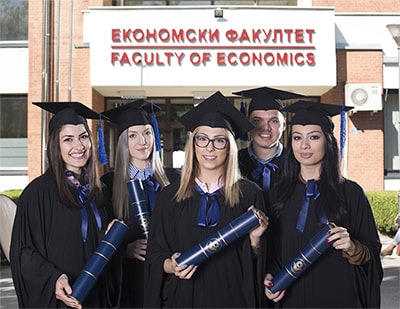
Faculty of Economics, University of Banja Luka, is a higher education institution whose main activity is scientific teaching and scientific research. Faculty of Economic in Banja Luka was established on 06th February 1975 according to the Decision of the Municipal Assembly of Banja Luka no. 01-012/75. The Faculty evolved from the Department of the Faculty of Economics, University of Sarajevo, which began its operations on 01st November 1974. Today, upon the adoption of the Law on Higher Education of the Republic of Srpska, the Faculty possesses all necessary licenses and fully meets all necessary requirements prescribed by the Law (the Decision on establishing the conditions for the commencement of higher education institution no. 07.1 - 4462/07 of 02nd July 2007, the Decision on entry into the register no. 1-587-00 of 13th September 2007 and the Operating license no. 07.23/602-3900/09 of 22nd June 2009).
Mission
The mission of the Faculty of Economics is education and training of highly educated academic and professional staff, development of market-oriented competencies of students, as well as scientific research and cooperation at national, regional and international levels with the scientific-research institutions, governmental and nongovernmental institutions and industry.
The vision of the Faculty of Economics
The Faculty of Economics of the University of Banja Luka is a modern, developed, progressive and open Faculty, which represents the backbone of economic development of the Republic of Srpska.
The main goal of the Faculty of Economics of the University of Banja Luka is to become a leader in the field of higher education and scientific research within the Republic of Srpska and Bosnia and Herzegovina, and broader, in the regional context.
The objectives of the Faculty are:
- Achieving excellence in teaching through the continuous enhancement of the quality of the teaching process across all study cycles, aligned with labour market requirements and students' academic aspirations.
- Strengthening research activities by increasing both the number and quality of research projects involving academic staff and students, as well as by increasing the number of publications in reputable scientific journals.
- Enhancing cooperation with regional and international higher education and research institutions in order to promote greater mobility of students and academic staff, and to increase the number of international students through international exchange programmes and degree studies.
- Strengthening cooperation with industry through professional development, technology transfer, and joint projects, with the aim of improving teaching and research activities while providing students with practical experience.
Core Values
Excellence – Continuous enhancement of the quality of the teaching process, in accordance with European standards, labour market requirements, and students' academic aspirations, while recognising and promoting outstanding student achievement.
Intellectual Curiosity and Motivation – Fostering academic independence and openness to the exchange of ideas, opinions, and perspectives.
Integrity and Responsibility – Promoting ethical and responsible conduct, as well as research activities carried out in the public interest.
Innovation and Adaptability – Recognising opportunities and addressing the challenges of a dynamic and uncertain environment through a flexible and innovative approach.
Respect for Diversity – Upholding the principles of equality and fairness regardless of gender, social status, nationality, or any other form of affiliation.
Stability – A higher education institution established in 1975, building upon a strong tradition of knowledge and experience developed and continuously enhanced through the work of generations, and committed to providing a stable academic environment.
Cooperation – Fostering collaboration with the academic community and industry through professional development, consultancy and expert studies, technology transfer, and joint projects.
Public Benefit – Recognising and addressing the needs of partners in promoting the development and sustainability of the wider community.